
Eternity: The False Dichotomy of A Great Love
A24’s “Eternity” premiered at TIFF this year with an amusing rom com premise: Joan (Elizabeth Olsen) finds herself in the afterlife, choosing whether to spend eternity with her first husband who died in the war (Luke, played by Callum Turner) or her second husband of 65 years (Larry, played by Miles Teller). It’s a classic who will she end up with? plot, which itself is not an issue as an opening premise. The part I found less compelling was how these two choices—the men and their love with Joan—was framed in such a reductive way. (Spoilers to come.)
Steady vs. Passionate Love
I will first admit that we are starved for good love stories. Most mainstream romances (especially in the rom com genre) still end with the couple getting together or overcoming a big obstacle that allows them to start the rest of their lives together. We have few examples that foreground the beauty of everyday love (N.B. I blogged about this topic in 2015). All to say, “Eternity" attempting just that—as Joan ultimately chooses Larry, her second husband—is not a bad thing. I appreciate that more nuanced depictions of love are being told, since love is, of course, sustained caring. I don’t, however, like how much passion and desire and joy was missing from their bond.
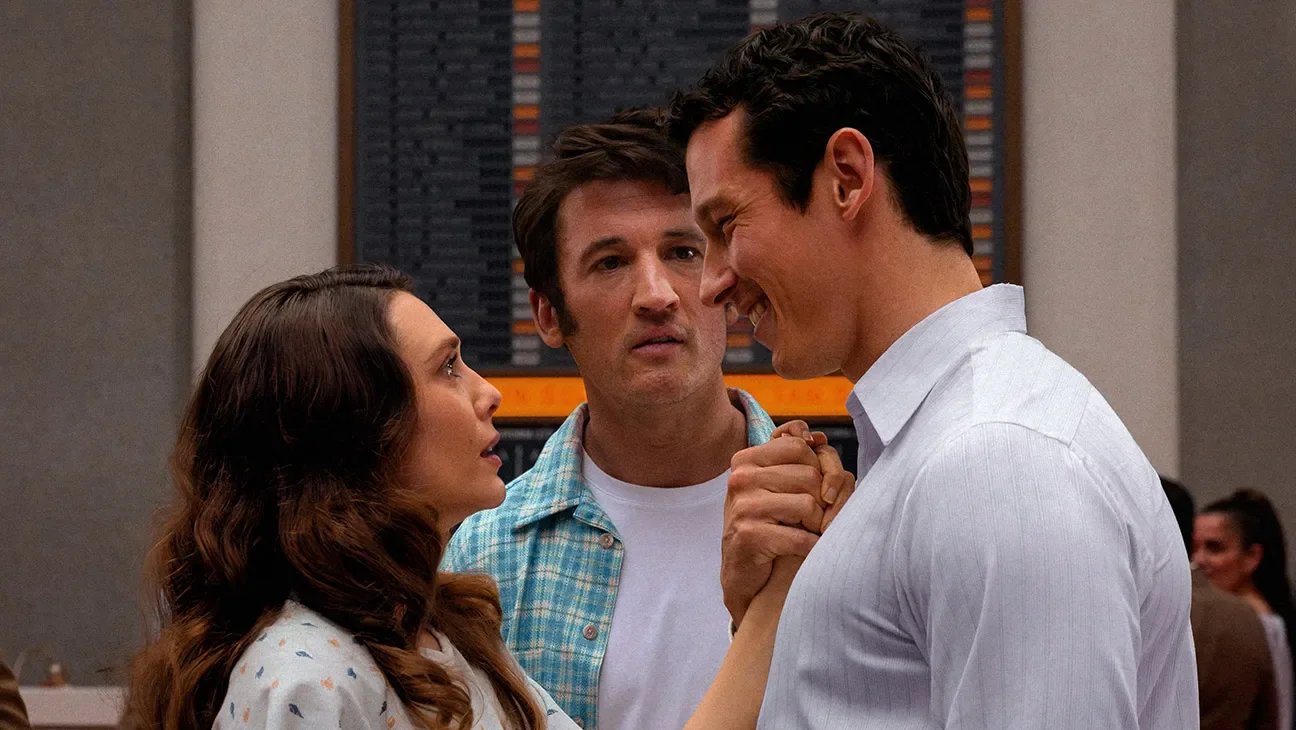
Eternity (Freyne, 2025)
Luke, the first husband, is conversely given these exact traits in his relationship with Joan. She returns to her happiest form in the afterlife, when she had been with him. Luke is the dashing first-love head-over-heels romance that swept Joan off her feet. He is adventurous, likes to hike, ski, and talk to new people. Their love is explicitly described as chemistry-laden and “sparky”. Larry, by contrast, is portrayed as a grumpy homebody. Throughout the story, he consistently wonders why Joan chose him—a question that we never hear answered in the film.
Of course, we understand that Larry loves Joan deeply. He knows her well and caters to her every need—but is that enough? Is it enough for women to choose men only because they are treated well? What about our own desires? Larry admits Joan deserves a “sparky” love (an admission that suggests they did not have such a love), but why can’t a sparky love co-exist with the stable everyday kind as well? We have bypassed the in-between, unable to sit with both/and of a relationship being at once thrilling and exciting as well as reliable and calming, but love is certainly not an either/or. In fact, much of love’s magic comes through in how the most mundane moments, like grocery shopping or cooking, feel “sparky” too.
Having encountered this narrative myself many times over the past decade, I know how harmful it can be. Women (especially over 25) face enormous pressure to settle down with someone just good enough, who treats you well enough. Wanting more is Icarian, irresponsible, and rash. Love gets rationalized into duty, responsibility, and hard work. The role of passion, desire, and unbridled joy are diluted and infantilized. This thinking easily leads to late nights of self-doubt and self-loathing, wondering why we can’t simply be content, why something feels missing, just like the women in this “Dear Sugar” column describe.
I am not saying that Joan feels this way, or even that Larry is the wrong choice. I actually agree that he likely is the right choice given how much Joan has grown and changed in 67 years. I just wish both relationships had been portrayed with more complexity. What, explicitly, does Joan love about Larry, beyond how well they know each other and how he treats her? What does he bring out in her? What passions does he provoke? How does he shape her view of the world? If we are sticking with this narrative, the choice itself could have been set up as one between two great loves: perhaps different in their interests and life trajectories but equally “sparky” as well as steady. The small moments as well as the big. A great love is, after all, both.
Audre Lorde and Why This Matters
This movie is one rom com, but the dichotomy it establishes resounds in what society tells us about love and marriage—to distrust the honeymoon phase, to treat love as sacrifice and hard work, to dismiss fiery love as childish and unsustainable—in constrast to the Disney happily-ever-after “love at first sight conquers all”, which clearly has its own issues. Love is the most expansive feeling one could possibly experience; reducing it to any kind of template is harmful (I say as a queer person). To outline the implications of this particular dichotomy though, I turn to Audre Lorde’s essay “Uses of the Erotic”:
As women, we have come to distrust that power which rises from our deepest and non-rational knowledge. We have been warned against it all our lives by the male world, which values this depth of feeling enough to keep women around in order to exercise it in the service of men, but which fears this same depth too much to examine the possibility of it within themselves.
“Uses of the Erotic” is about knowing and how the power of our deep, erotic knowledge has been stripped away by the same voice that reduces these feelings to immature fancies. Lorde’s essay was foundational to the work of other queer Black women like Alexis Pauline Gumbs and adrienne maree brown, whose “Pleasure Activism” relies on us understanding what love and joy feel like beyond the lines that capitalism has prescribed us. How can we explore these feelings if we mistrust them? If we keep dismissing “the truth that lives there”, to return to Cheryl Strayed’s “Dear Sugar” column and the women whose intuitions were not legitimate enough?
“Eternity” is not a bad film. However, I did not leave with any revelations or greater understanding of love. For a topic so vast and rich in potential—to challenge our ideas of monogamy, to explore how we change through love and how love shifts our views of the world, to examine assumptions of compatibility—a retreat into the suburban nuclear family as literal heaven felt disappointing. It left me longing to see more depictions of love as expansive, as unwieldy and world-making, as both/and, as powerful as many queer folks know it to be. What more can we want, if we let ourselves want? Where might our desires take us? What realities could we then enact?