
About this event
What if abolition is something that grows? – Alexis Pauline Gumbs
Is abolition a synonym for love? – Saidiya Hartman
Not abolition as the elimination of anything, but abolition as the founding of a new society – Stefano Harney and Fred Moten
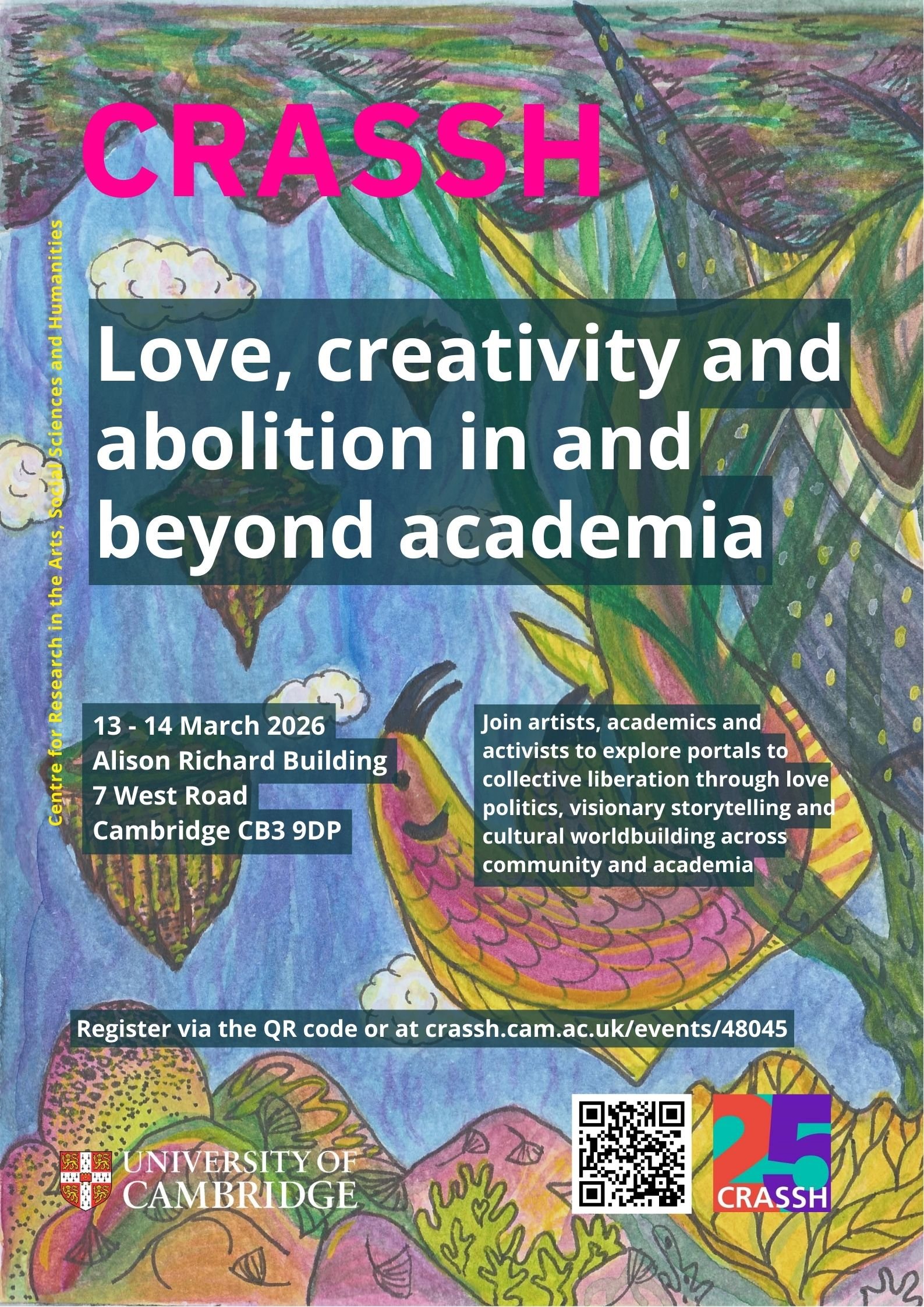
Join artists, academics and activists to explore portals to collective liberation through love politics, visionary storytelling and cultural worldbuilding across community and academia.
This two-day in-person gathering will explore the radical yet fraught relationship of love as a creative politically-engaged practice, with the revitalised turn to abolition in the wake of contemporary social and student freedom movements.
Abolitionist organising and teaching is more than resisting the unworlding of the world under racialised capitalist systemic oppression; it is a creative collective experiment of lovingly making Just Worlds we all want to live in.
While we often imagine academia as a site of knowledge production and social justice beyond institutional walls, as Audre Lorde said, universities can be ‘institutionally dehumanising’. Academia has capitalised on unacknowledged labour by historically marginalised intellectuals and communities at the forefront of revolutionary change. In the present moment of ongoing imperial violence, from all lands under occupation, to the state surveillance and suppression of students’ peaceful protests, the struggle for freedom is interconnected. Liberation binds us together, to land and to nature beyond the illusion of borders, identity-based supremacy and social hierarchies of trauma.
Under what conditions will community-university collaborations embody accountability and care for often marginalised, minoritised, and migrant people across lines of race, gender, sexuality, class, caste, ability, and anti-normative experiences? How do community and academic practitioners navigate disproportionate labour, hegemonic power and knowledge? Are we stuck in cycles of harm and temporary fixes of academia that is obsolete? What will it take to re-build life-affirming institutions after anti-racist, anti-colonial and feminist scholarship? These questions animate the event rooted in multiple creative lineages and artistic technologies of healing justice as a practice-ground and ceremony to stay present with each other and the ongoing social suffering (Alexis Pauline Gumbs 2020).
However, to resource our collective capacity to transform the world as we know it, we need to grow capacity to notice our own complicity with systems of oppression and see how our everyday inter-actions stand in the way of realising our dreams for collective liberation (adrienne maree brown 2024). This means practicing openness to reckon with the harmful legacies of white body supremacy in the history of abolition (Resmaa Menakem 2017), while also getting into the right relationship with creativity beyond the often-romanticised feel-good notion of love and the arts in social justice.
Whether practices and scholarship are explicitly called abolitionist or not, this event is relevant to justice-centred interdisciplinary work across law and imprisonment, education, disability, health, migration, class, gender, queer, trans, racial, caste, environmental, sociological causes and more. The multi-format programme will include performances, poetry, talks, workshops, panels and films screenings. Join us to rehearse resistance, renewal and re-worlding at the crossroads of community and academia (Ruth Wilson Gilmore 2022).
Convened by
Dita N Love (Homerton College, University of Cambridge)
Co-convenors
Bhumika Billa (Faculty of Law, University of Cambridge)
Linh S. Nguyễn (Faculty of Education, University of Cambridge
Featured Speakers:
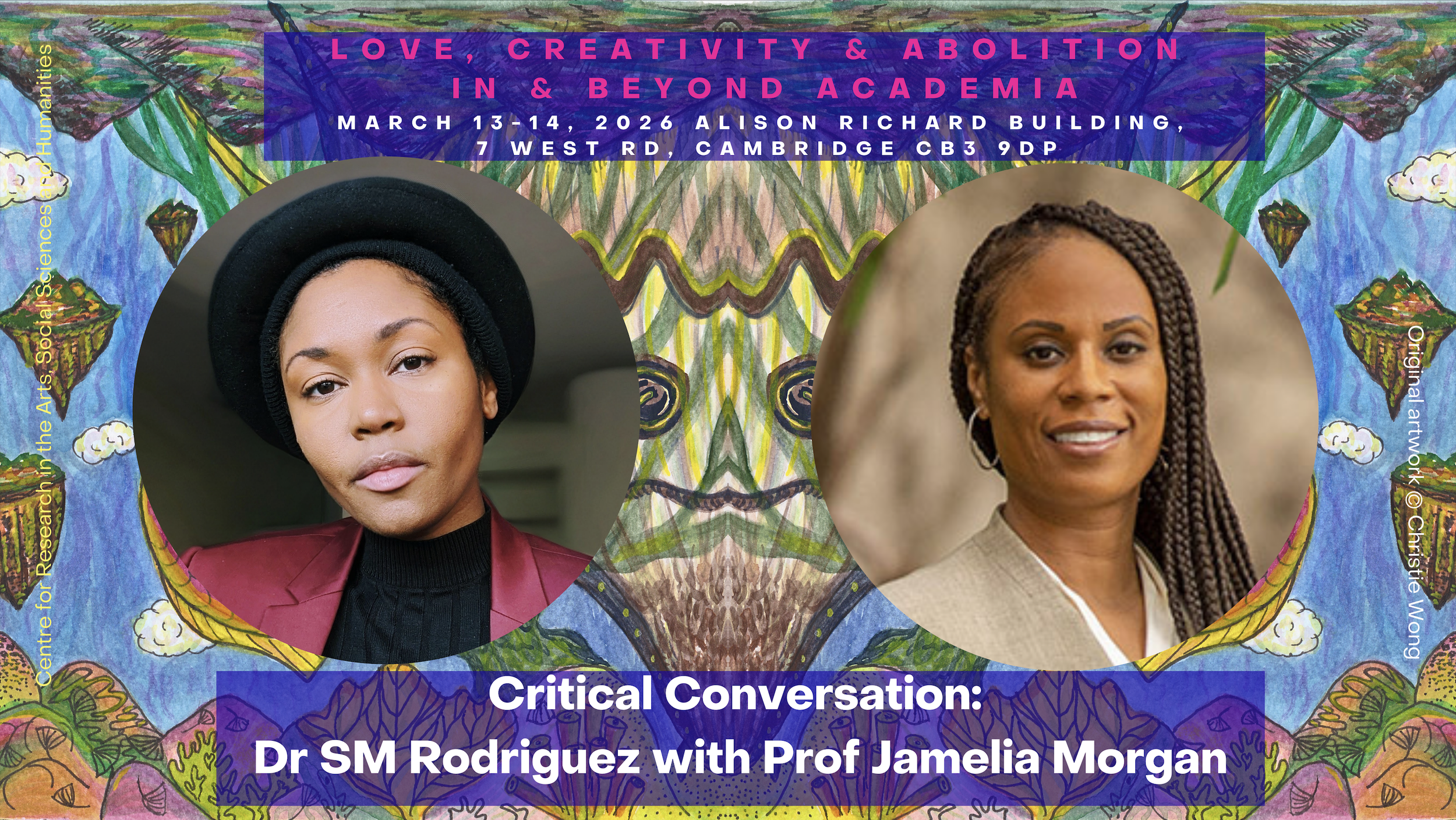
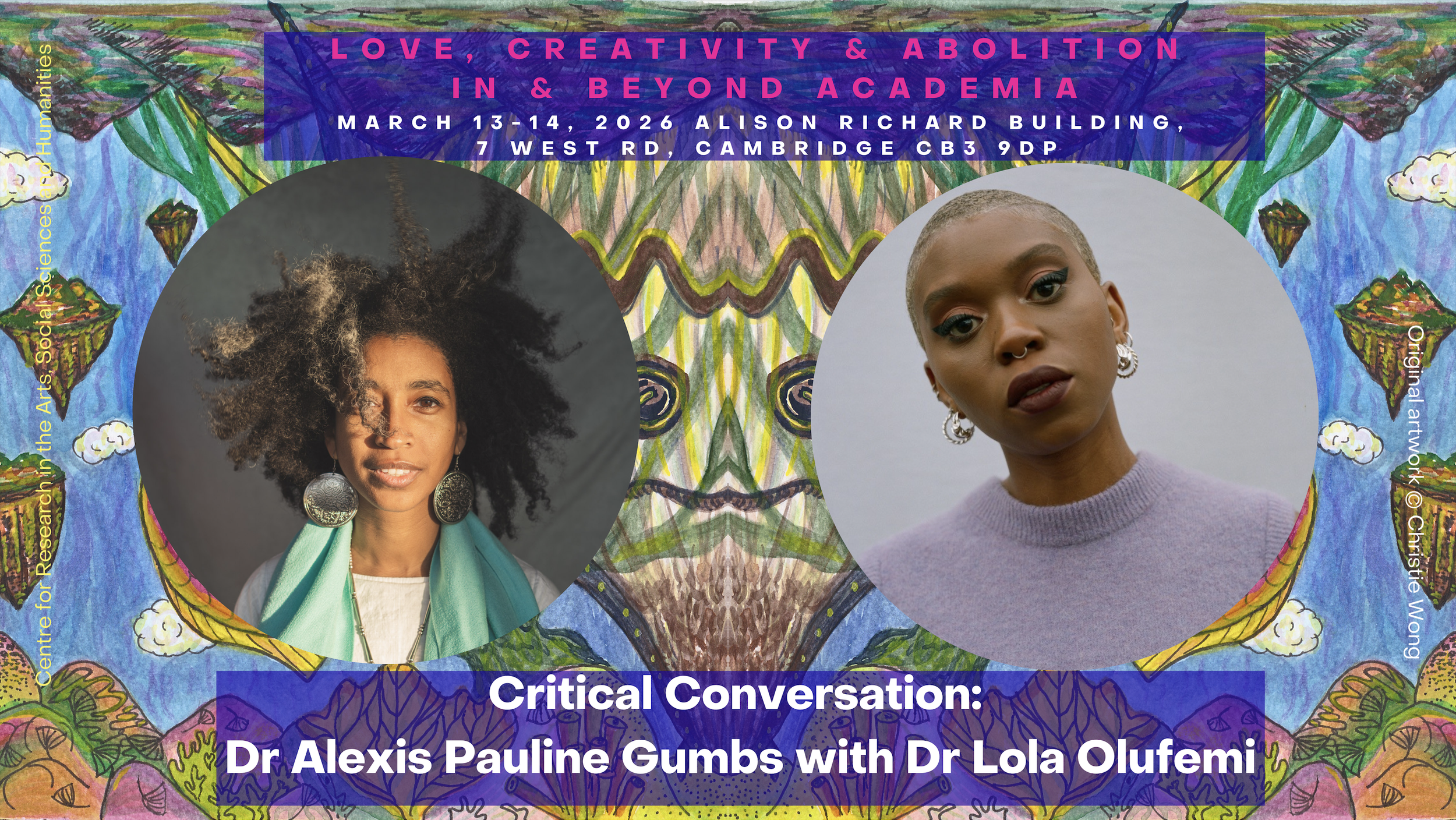
Speakers:
Alexis Pauline Gumbs (Writer, Independent Scholar, Activist)
S.M. Rodriguez (Assistant Professor of Gender, Rights and Human Rights, LSE)
Sanah Ahsan (Poet, psychologist, London)
Princess Arinola Adegbite (Poet, Artist and Filmmaker, Manchester)
Khawla Badwan (Reader in TESOL and Applied Linguistics, Manchester Metropolitan University)
Jay Bernard (Author, Writer, Poet and Playwright, London)
Malika Booker (Lecturer, poet, MMU)
Zena Edwards (Curator, Artist and Poet, London)
Kwamou Eva Feukeu (Researcher, Max Planck Institute for Comparative and International Private Law)
Jasmine Gardosi (Writer, Poet and Activist, Birmingham)
Mona Jebril (Interdisciplinary Social Scientist, University of Cambridge)
Zain Kakooza (Poet and Homerton College BME Society Officer)
Joon Lynn-Goh (Artist, Organiser and Founding Director of Migrants in Culture)
Ryan Matthews-Robinson (Director and Founder of Poetic Unity, London)
Anamika Misra (Lecturer, The City Law School, City St George’s, University of London)
Jamelia Morgan (Professor of Law, Northwestern University)
Adèle Oliver (Author, Artist and Scholar-activist, Art not Evidence)
Lola Olufemi (Writer, Scholar, Activist, London)
Rosalie Schweiker (Designer, Organiser and Co-director of Migrants in Culture)
Kai Syng Tan (Associate Professor in Arts and Cultural Leadership, University of Southampton)
Rémy-Paulin Twahirwa (Scholar-activist, LSE)