
EMOTION AND EMOTIONALITY: THE MULTI-AFFECTS OF THE GLOBAL SOUTH
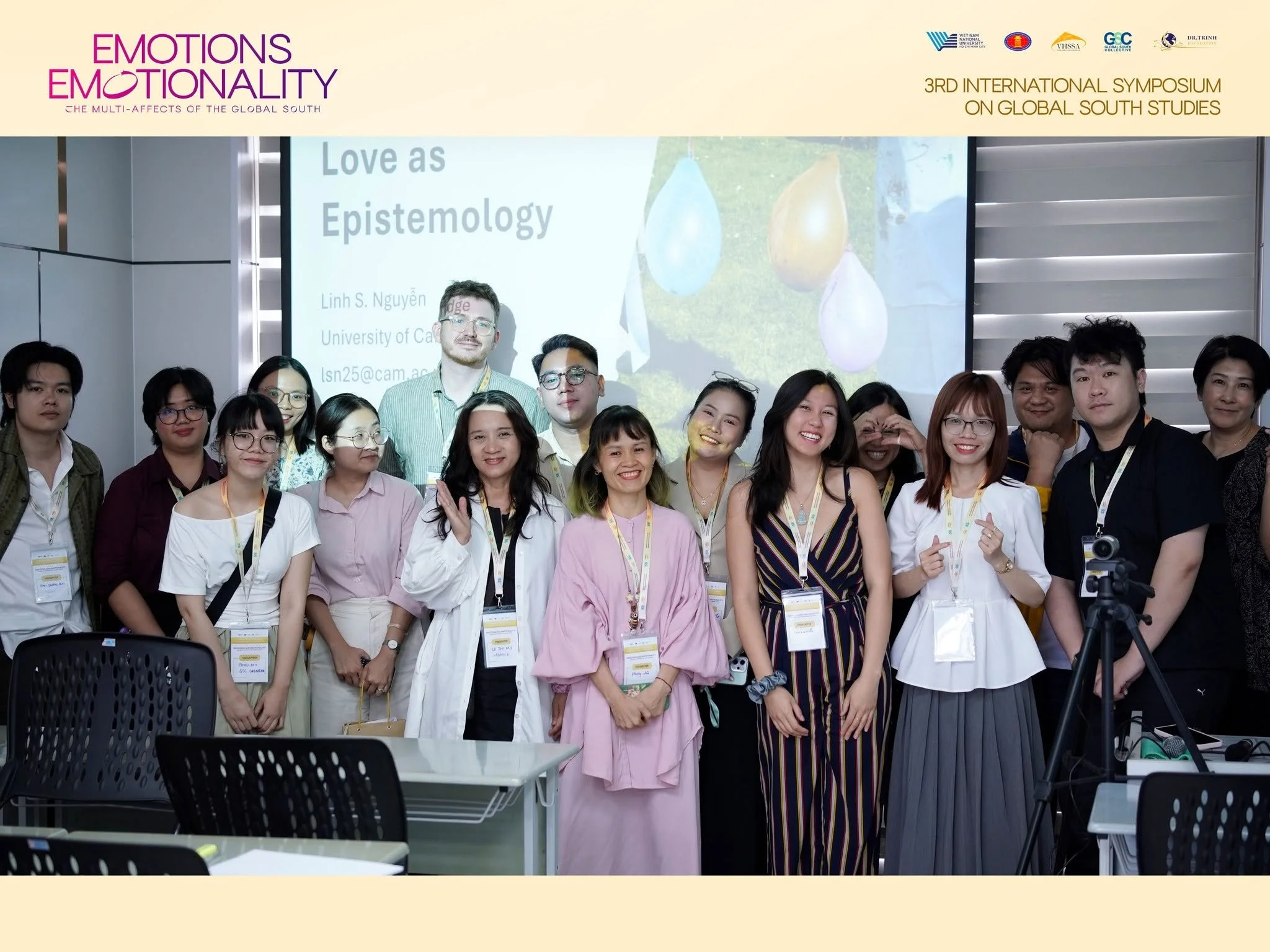
Love as Epistemology: A Multi-Registered Creative Writing Workshop
This session presents love as an epistemological opening in response to the systemic de-legitimization of emotion and embodiment in Western institutions (hooks, 2014). I rely on key frameworks outlined by feminist pedagogues such as bell hooks, Audre Lorde (Lorde, 2018), and Ursula K. Le Guin (Le Guin, 1989) to challenge what is considered “extraneous” in traditional Western epistemology, arguing that love and desire are crucial to dismantling colonial understandings of “legitimate knowledge” (Akena, 2012, p. 600). As knowing/being are entangled with foundational consequences for power (Paris & Winn, 2014, p. 224), such a re-framing affects whose knowledges/existences are validated.
These issues are examined in a creative writing workshop that counters Western narratives of emotion and relationships as superfluous. I treat love as an epistemological site erased by imperialist systems (Nguyễn, 2026), defined beyond neoliberal assumptions. Instead, love is posited as a revolutionary (hooks, 2018) and queering force: “a lived openness that invites us to seek out new ways of being” (Burke, 2017, p. 55). These theories intersect with decolonial scholarship (Smith, 2012) that highlight how sharing, storytelling, connecting, envisioning—activities based in love—have existed as knowledge-making for centuries, offering a response to the violence inflicted by capitalism.
This workshop teaches participants to notice and enact love as meaning-making. We start by discussing how love as epistemology refutes a “dualist ontology”: “separation between subject and object, reason and emotion” (Escobar & Frye, 2020, p. 2), resulting in different understandings of subjectivities, realities, and what counts as knowledge. We then move into arts-based, process-oriented exercises to practice “attending to spillage” as method (Ahmed, 2021, p. 18), which requires entering into relationship with movement, bodies, and pleasure. With multilingual and multi-registered writing prompts, I guide participants through activities like list-building, hugging (Qiu, 2025), foraging, and sketching feelings aligned with new materialist groundings in sympoiesis, entanglement, and “staying with the trouble” (Haraway, 2016). These methods invite care to emergence, holding emotions, and embracing love and desire as ways of creating knowledge in community (Lorde, 2018).